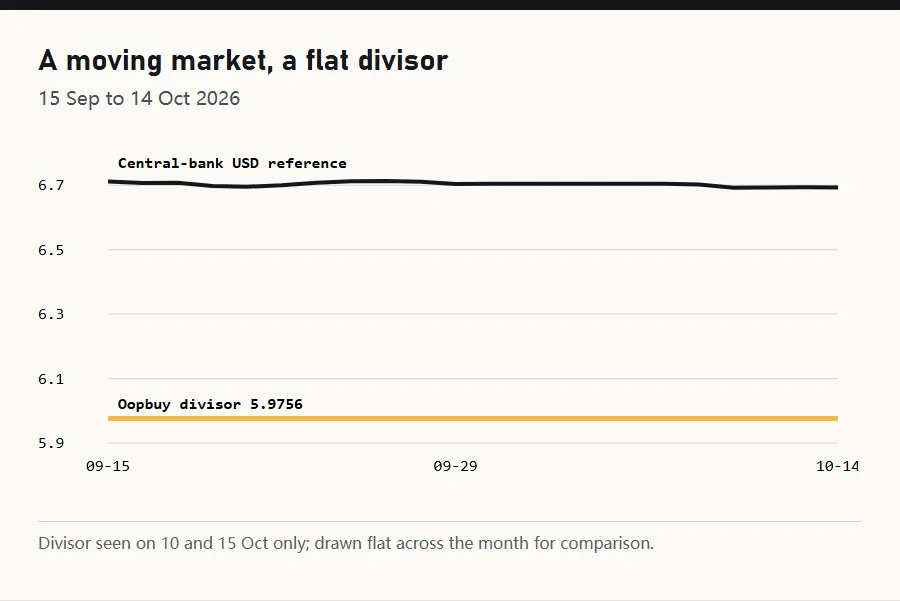
How far the Oopbuy rate sits from the mid-market rate
The divisor on its own says little. Set it beside a market rate on the same day and it becomes a percentage you can carry into any purchase. Here is that comparison for every currency Oopbuy can display.
What a mid-market rate is, and where ours come from
The mid-market rate is the midpoint between what banks pay and charge each other for a currency at a given moment. Nobody retail ever gets it exactly; it is a reference, the fairest single number there is. Banks, card networks and payment apps all add something to it.
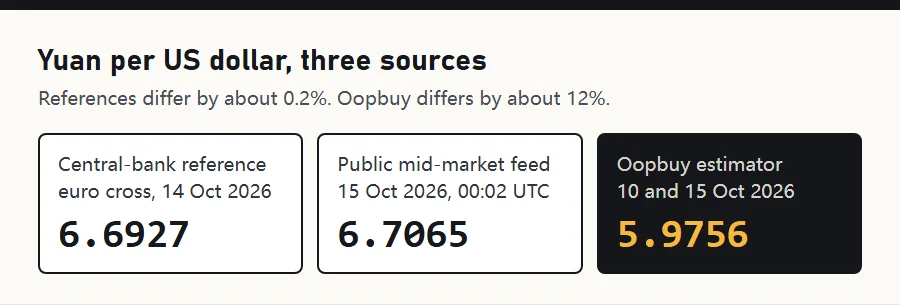
We used two public references. The first is a central-bank reference rate, published once each business day, here for 14 October 2026 and cross-calculated through the euro. The second is a public mid-market feed that updates through the day, read at 00:02 UTC on 15 October 2026. Both are free to check and both are linked from most currency apps.
They differ slightly, as references always do. For the dollar: 6.6927 yuan from the central bank, 6.7065 from the feed. We print both, and we never call either of them the rate you will get.
The gap in all nineteen display currencies
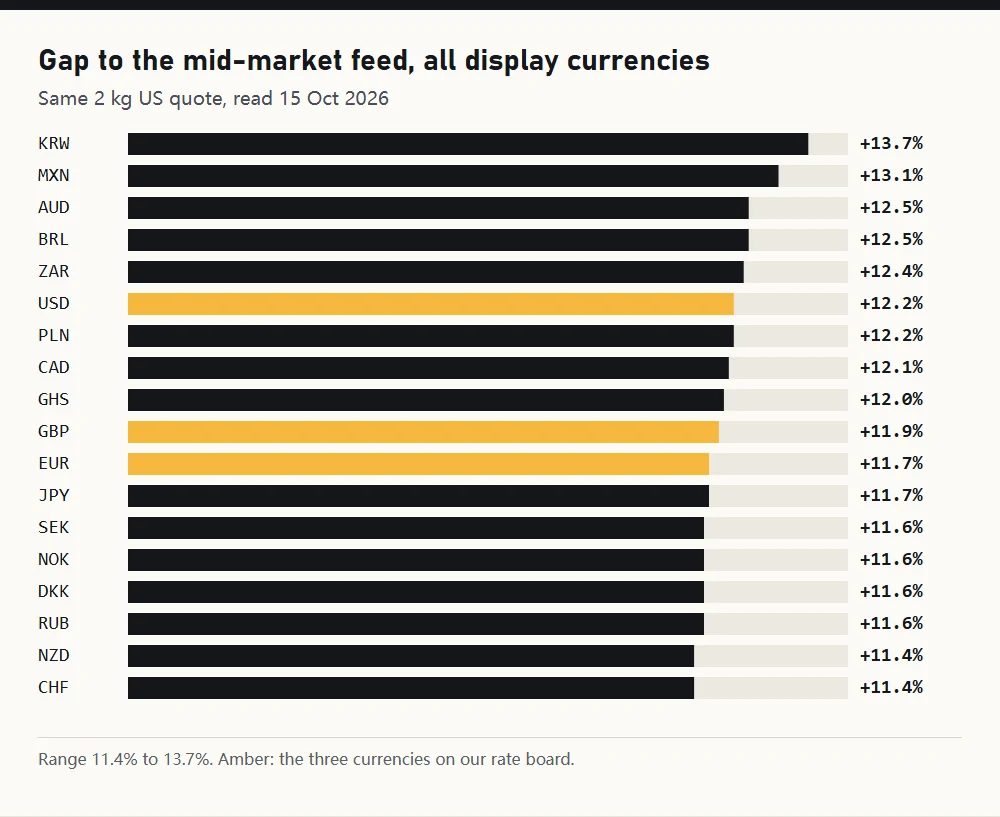
Oopbuy's currency menu offers 19 currencies. We ran the same 2 kg US quote in each one on 15 October 2026 and divided the yuan total by the displayed total. Then we set each divisor beside two references.
Read the table as: how many yuan does one unit of your money buy at Oopbuy, how many would it buy at the mid rate, and how much more expensive does that make a yuan price look in your currency.
| Code | Currency | Oopbuy divisor | Mid-market (feed) | Gap to feed | Gap to central bank |
|---|---|---|---|---|---|
| USD | US dollar | 5.9772 | 6.7065 | +12.2% | +12.0% |
| EUR | Euro | 6.7069 | 7.4897 | +11.7% | +11.7% |
| GBP | Pound sterling | 7.9176 | 8.8598 | +11.9% | +12.1% |
| AUD | Australian dollar | 4.1563 | 4.6759 | +12.5% | +12.9% |
| CAD | Canadian dollar | 4.2052 | 4.7123 | +12.1% | +11.9% |
| NZD | New Zealand dollar | 3.3602 | 3.7443 | +11.4% | +11.8% |
| CHF | Swiss franc | 7.2097 | 8.0331 | +11.4% | +11.4% |
| PLN | Polish zloty | 1.5342 | 1.7212 | +12.2% | +11.9% |
| SEK | Swedish krona | 0.5997 | 0.6690 | +11.6% | +12.0% |
| NOK | Norwegian krone | 0.6297 | 0.7029 | +11.6% | +12.2% |
| DKK | Danish krone | 0.8971 | 1.0011 | +11.6% | +11.7% |
| BRL | Brazilian real | 1.1838 | 1.3315 | +12.5% | +12.5% |
| MXN | Mexican peso | 0.3234 | 0.3658 | +13.1% | +12.7% |
| ZAR | South African rand | 0.3611 | 0.4058 | +12.4% | +12.5% |
| JPY | Japanese yen | 0.03790 | 0.04234 | +11.7% | +11.4% |
| KRW | South Korean won | 0.004400 | 0.005001 | +13.7% | +13.8% |
| RUB | Russian rouble | 0.07150 | 0.07980 | +11.6% | n/a |
| GHS | Ghanaian cedi | 0.5125 | 0.5739 | +12.0% | n/a |
The gap ranges from 11.4% to 13.7%. No currency gets a near-market rate, and none is singled out for a much worse one. That evenness suggests one policy applied to all currencies, rather than a rate that tracks each market. The wider gaps on the won and the peso look like rounding at a small unit size and a slower update; we would not read anything into a one or two point difference.
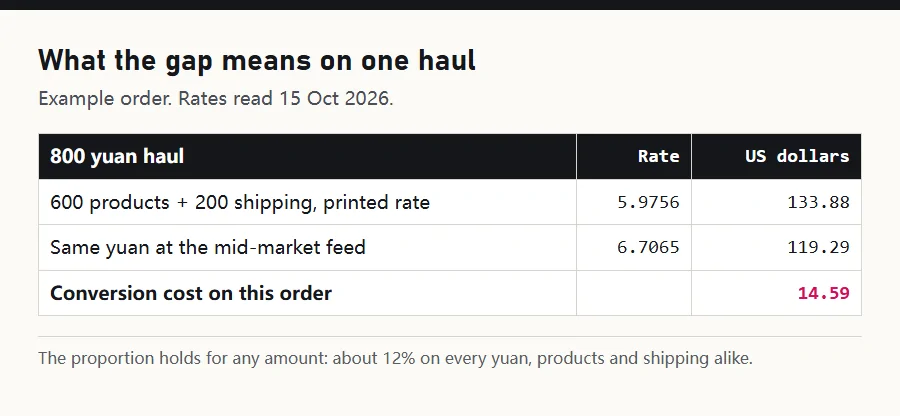
What twelve percent means on a real order
Take a haul with 600 yuan of products and a 200 yuan shipping line: 800 yuan in total. At the printed rate that is about 133.88 dollars. At the feed rate it would be about 119.29 dollars. The difference, about 14.59 dollars, is what the conversion costs on that order.
Scale it as you like; it stays proportional. The rate does not care whether the yuan went on products, shipping, photos or a storage extension. Twelve percent on everything, no matter which line it is printed on.
Set that beside agents that charge a visible service fee of five to ten percent on products only, and the comparison gets interesting. Costs, line by line works one example through in full.
How the gap compares with paying a bank or card directly
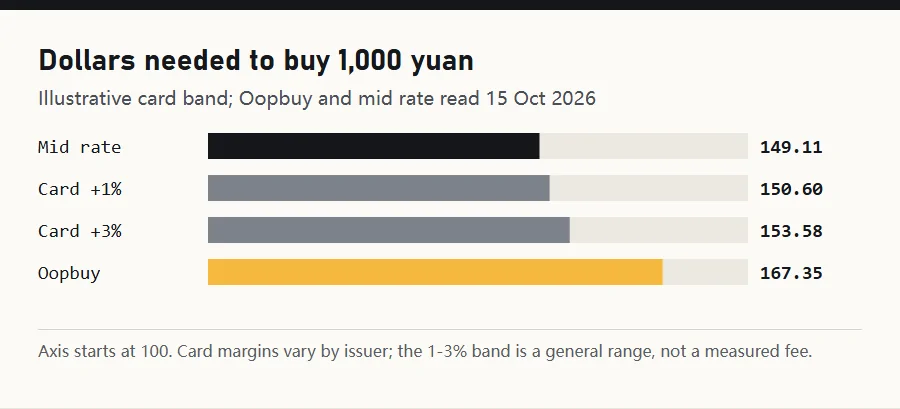
A useful baseline: if you converted the money yourself with a typical card or bank, you would not get the mid rate either. Cards and banks commonly add one to three percent; some travel cards add nothing on weekdays. That is general market practice, not something Oopbuy publishes.
So the honest comparison is not twelve percent against zero. It is twelve percent against whatever your own bank would charge to put yuan in a Chinese account, plus whatever another agent would add on top. For most buyers the second number is the one that matters, because nobody pays a Taobao seller directly from abroad.
Oopbuy also adds its PayPal top-up fee of 4.5% + $0.30, which is separate from the conversion and is paid on the way in. We cover it on the payment path page.
When the gap could change
The divisor is fixed between updates, so the gap moves every day with the market. If the yuan strengthens, the gap shrinks; if it weakens, the gap grows. Over the month to 14 October 2026 the central-bank dollar rate ranged from 6.6921 to 6.7132, enough to move the gap by about half a point.
Then, at some point, Oopbuy will move the divisor. The help pages say the rate follows the Bank of China and is adjusted from time to time. They do not say how often or by what rule. We take a fresh reading when we update these notes and log it on the updates page.
If you take your own reading and get a different divisor, tell us the date and the two figures. Corrections with numbers attached are the most useful mail we get.