
The Oopbuy Spreadsheet categories, and how to read a price before it is converted
Sixteen categories, each linking to live listings. Below the wall: what a finds list is for, how to read the yuan price that sits under every converted figure, and how to pick an item without letting the display currency mislead you.
All sixteen Oopbuy Spreadsheet categories
Same order as the home page: lightest parcels first. Womenswear is a keyword search, not a single category, so its page is broader than the others.
 Jewellery and chainsGrams, not kilos. The item price is nearly the whole bill here.Category
 Sunglasses and framesLight, but cases and boxes add weight you may not want to ship.Category
 BeltsA belt ships flat. Leave the gift box behind and the parcel stays small.Category
 Caps and beaniesSoft beanies pack small; stiff caps take volume.Category
 TeesThe easiest category to price: light, flat, and rarely boxed.Category
 Fragrance and setsLiquids limit the routes you can pick, so check the line before you pay.Category
 Football shirtsShirts are light; full kits with shorts add up across a haul.Category
 Womenswear findsA keyword search rather than a single category, so expect a mixed page.Search results
 WristwatchesSmall, but the box and the battery rules matter more than the grams.Category
 Gadgets and audioBatteries narrow the route list; the estimator flags which lines accept them.Category
 HoodiesHeavy fabric. Two hoodies can outweigh five tees.Category
 Joggers and track pantsMid weight; vacuum bagging on some lines keeps the volume down.Category
 DenimDenim is dense. Weight climbs faster than you expect across a haul.Category
 BagsStructured bags carry stuffing and dust bags; ask for them to be removed if you can.Category
 SneakersShoe boxes are the classic volume trap on the second payment.Category
 Coats and jacketsThe heaviest corner of most hauls, and the one where line choice moves the total most.Category
What is an Oopbuy Spreadsheet
Shoppers use the phrase for a curated catalogue of product finds that you then order through Oopbuy. You browse picks by category, open the ones you like, and paste the listing link into the agent. The list does not sell anything; it points.
Lists like this exist because Chinese marketplaces are hard to search from outside: the listings are in Chinese, titles are stuffed with keywords, and the same item appears under dozens of shops. A good list saves the searching. It cannot vouch for the seller, which is why the checks on Choosing still apply.
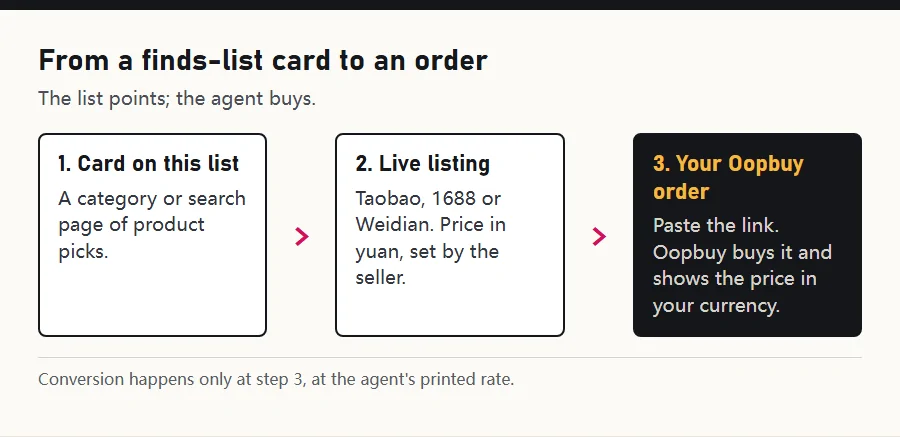
Our list sorts categories by parcel weight instead of popularity. That is a deliberate choice for a site about conversion: weight drives the second payment, and the second payment is converted at the same printed rate.
Reading the yuan price under every converted figure
Every product on Taobao, 1688 and Weidian is priced in yuan. Oopbuy's search and product pages show your currency next to it, converted at its printed rate. When you compare items, compare the yuan figures. They are the seller's price and they do not move with anyone's rate.
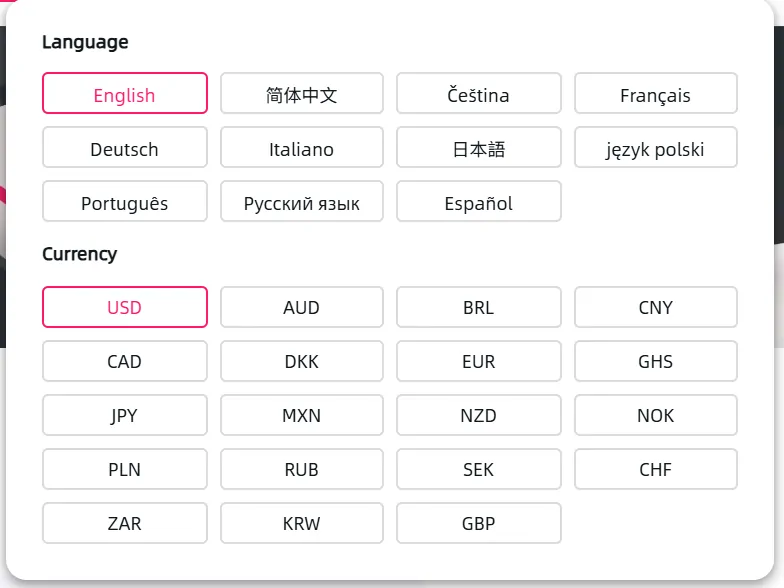
A useful habit: before you add anything to the cart, switch the site's display currency to CNY for a minute. The currency menu sits behind the globe icon in the header and offers 19 currencies, yuan among them. What you see then is the price the agent pays the seller, plus the seller's own domestic freight.
Then switch back. The converted figure is what your balance will be charged in practice, so it matters, but it is the yuan figure that tells you whether the item is priced fairly.
How to choose a product when the display currency moves
Picking an item has nothing to do with exchange rates, and the usual tests apply. Read the photos before the title. Look for seller photos taken in a real room, not only studio shots. Check the size chart against a garment you own, in centimetres. Read the sales count and the review photos where the platform shows them.
Two habits are specific to converted prices. First, judge a bargain in yuan: a listing that looks a few dollars cheaper on one agent may be the same yuan price under a different rate. Second, budget with the current converted quote and payment-channel charges. If the amount is already converted by Oopbuy, do not add the historical observed rate gap a second time.
Finally, think about the second payment while you choose. A jacket that is a bargain at the seller can stop being one once its weight is priced, converted, and added.
Where category links go, and what we do not do
Category cards and the search box open product listings. They are discovery links: no order is placed, no payment is taken, and nothing on this site holds your money. When you are ready to buy, the purchase happens inside your Oopbuy account.
We do not run local product pages, we do not quote prices for individual items, and we do not grade sellers. Prices on listings change daily and sellers come and go; any number we printed would be wrong within a week.
We publish dated observations and a calculator you can use with your own current figures. A historical conversion reading is a comparison input, not a guaranteed rate for a future payment.
A short list you can actually compare
Save the original marketplace URL, exact variant, CNY price, domestic freight and size chart for each candidate. If two cards look alike, compare the seller and measurements rather than assuming they share stock. A lower displayed price can reflect a different variant, minimum quantity or exchange rate.
For a first order, start with an item whose size and materials you understand. Ask about return eligibility and shipping restrictions before buying batteries, liquids or other restricted goods. If the seller link has disappeared, find a new listing and repeat the checks; a replacement photo is not proof of the same item.
When you have a candidate, continue with the buying guide. This catalogue never checks out or pays on your behalf.