
The fixed divisor behind Oopbuy dollar prices
How we found the number, how to reproduce it from the public estimator in five minutes, and the small rounding pattern that makes cheap quotes read a little lower than expensive ones.
Where the Oopbuy exchange rate shows itself
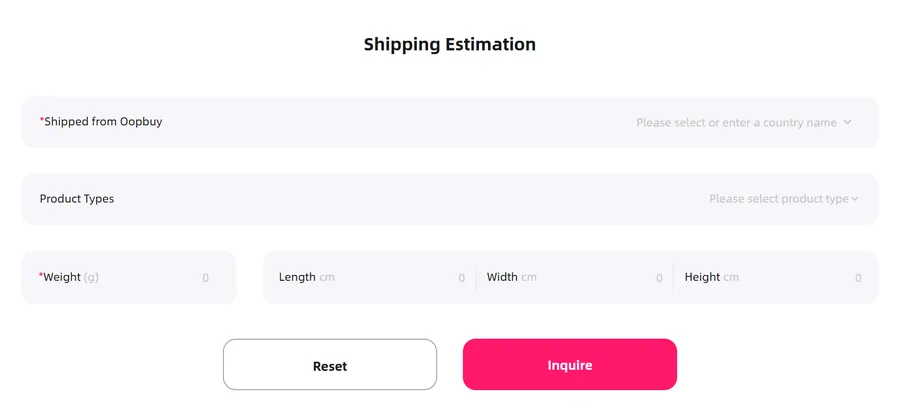
Oopbuy's shipping estimator at oopbuy.com/estimation needs no account. Pick a destination, a product type and a weight, and it returns every line that will carry the parcel, each with a price in your chosen display currency. Behind the page, each line arrives with two totals: one in yuan and one in the display currency.
On 15 October 2026 we asked for 1 kg of common goods to the United States. The first line, DDF-GOFO-US-1, came back at 200.72 yuan and 33.59 dollars. That pair is the whole story in miniature: 200.72 divided by 33.59 is 5.9756.
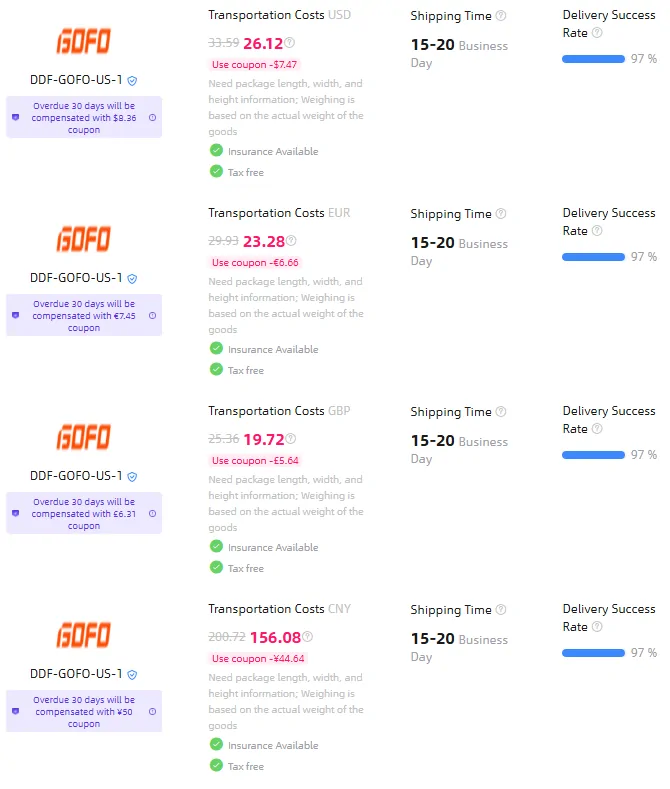
The same request five days earlier, on 10 October 2026, returned the same two figures. The capture on the right is the same line in four display currencies on the later date, with a coupon applied on top.
Notice the small purple badge under each logo. It promises a coupon if delivery runs 30 days late: 50 yuan, shown as 8.36 dollars, 7.45 euros or 6.31 pounds. Even a promise of compensation passes through the same fixed conversion, which is a neat way to see that the rate is applied to every yuan figure on the page, not only to prices.
Why every line gives the same number
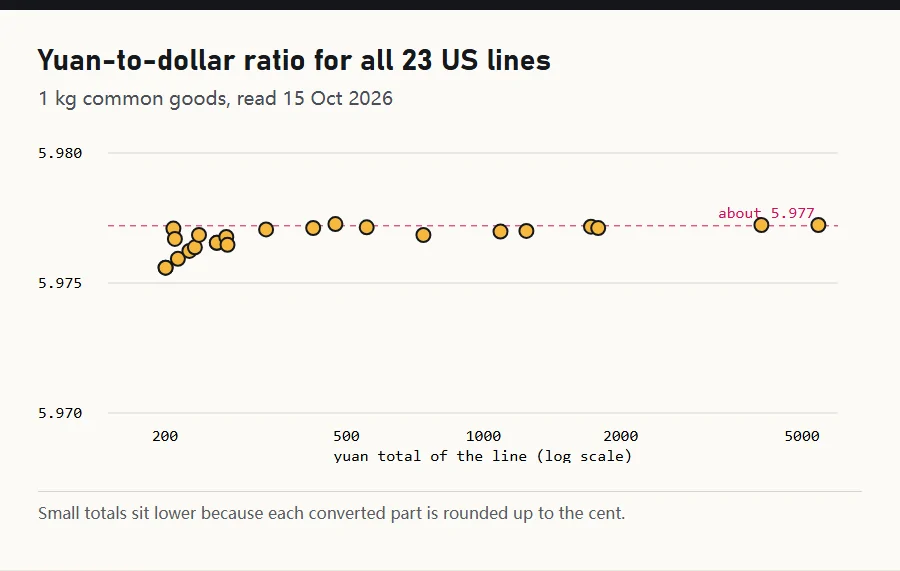
A real exchange rate would be one number applied to everything, and that is what we see. Across the 23 US lines for 1 kg, the ratio of yuan to dollars never leaves the band 5.9748 to 5.9773. Repeat the request for the UK, for Germany, for 500 g and for 2 kg, and the band does not move.
The lines themselves could not be more different. Prices run from 200.72 yuan to 5,434.32 yuan, carriers range from postal small-packet lines to express couriers, and some lines are duty-paid while others are not. None of that changes the conversion. Whatever the parcel, the yuan total is divided by the same figure.
That is why we call it a divisor rather than a rate: it is a constant the site applies, not a price discovered in a market that morning.
Why small quotes read lower than large ones
Look closely and the ratio drifts a little with the size of the quote: 5.9756 on a 200 yuan line, about 5.977 on a 5,000 yuan line. The cause is rounding, not a second rate.
Each quote is built from parts: a weight fee, a fuel fee, an operating fee of 10.32 yuan, and on some lines a clearance fee. In the figures we read, the conversion rounds up to the next cent, part by part on the cheap line we traced. Rounding up a few cents on a small total pushes the dollar figure up and the apparent ratio down. On a large total the same few cents vanish.
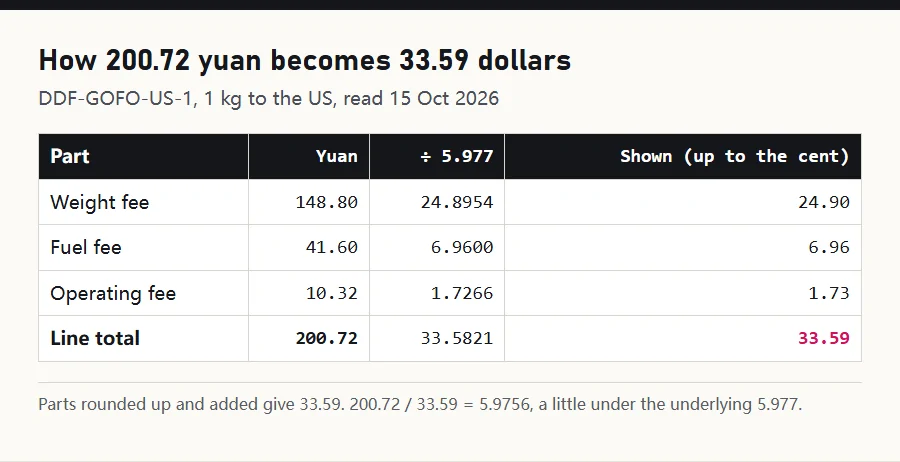
So the underlying figure is about 5.977 yuan per dollar, and the low-priced lines read slightly worse than that because of cents. For a buyer the difference is trivial: on a 33.59 dollar quote it is about one cent. We use 5.9756 as the headline because it is the ratio you will actually compute from the first line you see.
What changed between our two readings, and what did not
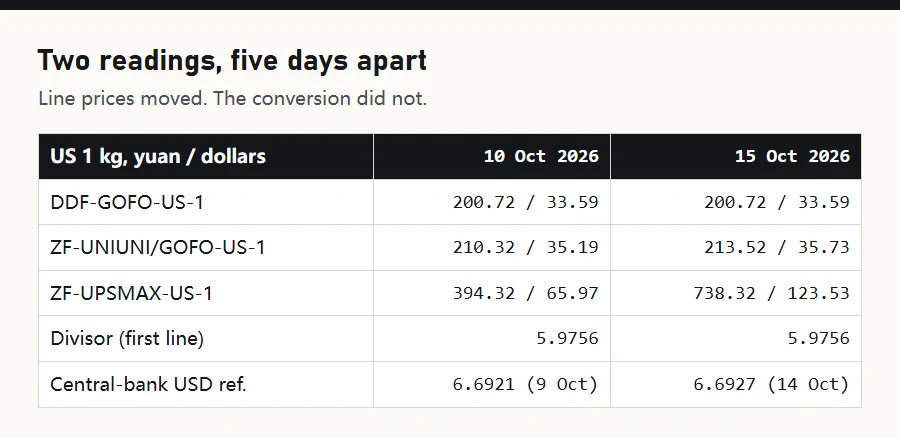
Between 10 October 2026 and 15 October 2026 some line prices moved. One UNI/GOFO line went from 210.32 to 213.52 yuan; one UPS line nearly doubled. The order of the low-cost lines shuffled. That is normal: carriers reprice, fuel surcharges change.
The conversion did not move at all. In the same five days a central-bank reference rate for the dollar moved between 6.6921 and 6.6938, and a public mid-market feed read 6.7065 on the second date. The divisor stayed at 5.9756.
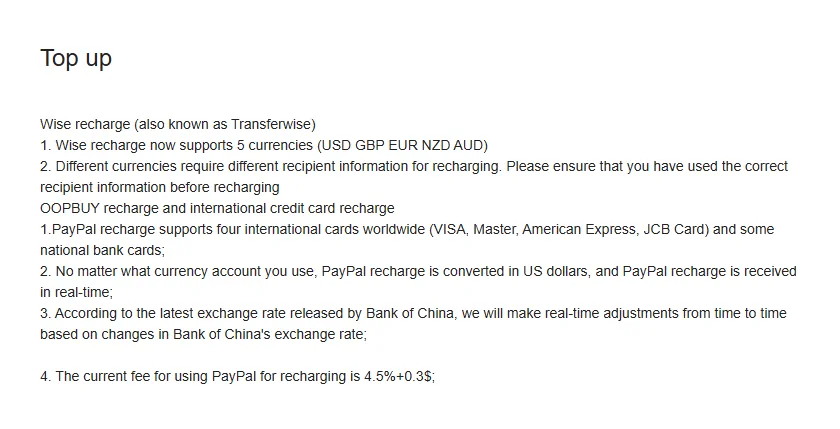
Two readings are not a history. Oopbuy's own top-up page says it follows the Bank of China rate and adjusts 'from time to time', so the figure can change. When it does, the readings log will record the date we saw it.
How to reproduce the divisor yourself
- Open oopbuy.com/estimation. No login is needed.
- Choose your country, leave product type on common goods, and enter 1000 g.
- Press Inquire and note the struck-through price on any line, in your display currency.
- Open the globe menu in the header, switch the currency to CNY, and run the same query.
- Divide the yuan figure by your currency figure for the same line. That is your divisor for today.
- Repeat with the largest line on the list for a figure less affected by rounding.
Use the struck-through price, not the pink coupon price. The coupon is applied to part of the quote and rounded on its own, which muddies the ratio. Then put your two figures into the quote checker to see the gap against a mid rate of your choice.
What the divisor is not
It is not a fee you can avoid by paying differently. The conversion applies to how prices are shown and, as far as the official pages say, to how your balance is valued. Paying with Wise in euros or with a card in pounds does not switch it off.
It is not secret either. Every number on this page comes from a public page anyone can load. What is missing is a sentence on the site that says 'our rate is X'. The top-up page says the rate follows the Bank of China and is adjusted from time to time; it does not print the figure.
And it is not unusual. Many agents with a zero or low service fee earn on conversion. The useful question is never whether an agent has a rate spread, but how big it is and whether the total beats the alternatives. Choosing covers that comparison.